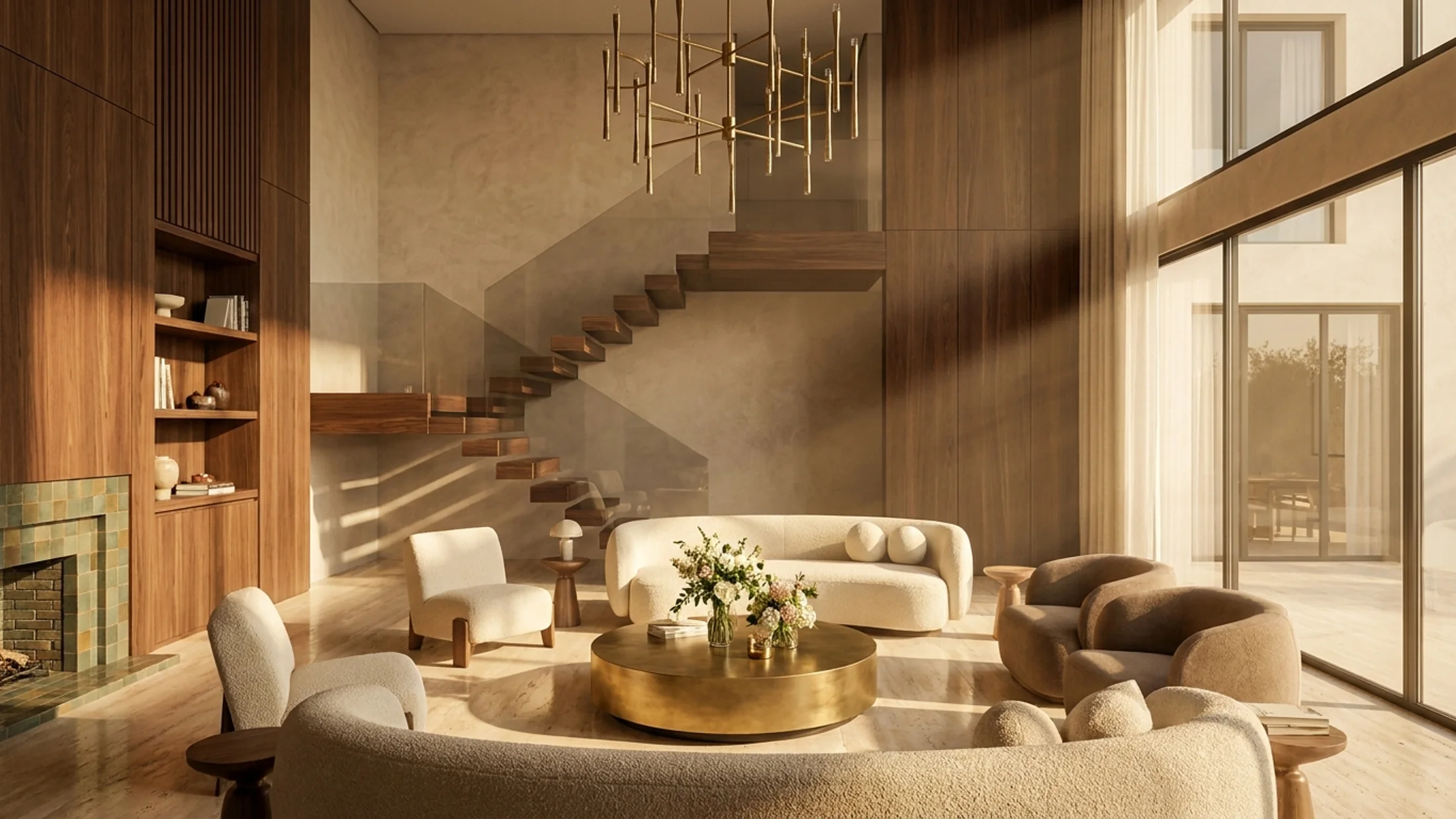

The choice of materials is immediately visible, but its most important effects are felt later, in the heat of a late afternoon, in the noise traveling from one room to another, in traces of moisture, in maintenance that becomes burdensome. For a house, villa, or apartment building in Morocco, a durable material does not only mean a solid material. You must consider its actual behavior in your climate, its compatibility with the structure, the quality of its installation, and its availability. At the Journal d'Art & Architecture, we often see the same mistake: a homeowner approves a material because they like its appearance, only to discover too late that it heats up, gets dirty, sounds hollow, or ages poorly.
Why durable materials truly change the outcome
A durable material is not necessarily a local material. A local material is not necessarily low-emission. And a material promoted on social media is not necessarily suitable for your project. These concepts must be separated.
- Durable: it withstands time well, with reasonable maintenance.
- Local: it is available in your region or in Morocco, which can simplify supply and monitoring.
- Low-emission: it releases few harmful compounds into indoor air, a useful point for paints, adhesives, panels, and varnishes.
- Trendy: it is visually appealing, but that says nothing about its performance.
The right choice improves summer comfort, limits certain issues, reduces rework, and makes the home more pleasant daily. The wrong choice often produces the opposite effect: overheating, noise, difficult maintenance, uneven aging, cracks, or moisture at junctions. That is why the topic can never be reduced to a list of materials. You must always connect the material to the site, exposure, structure, and expected level of finish.
Another important point is overall coherence. A well-designed roof, suitable walls, and good solar protection often yield a better result than a material presented as miraculous. If you are hesitating between several solutions, design and construction monitoring support helps compare choices before they become costly to correct.
Which materials to compare for walls, roofing, and finishes
For walls, do not only look at appearance or thickness. Compare resistance to the local climate, thermal inertia, acoustic insulation, ease of installation, and compatibility with the load-bearing structure. Some materials store coolness better. Others require careful protection against moisture or precise details at sills and corners. If you add insulation, ensure that the wall, insulation, render, or cladding system works as a system, not as an improvised assembly.
For roofing, the choice heavily impacts comfort. A poorly adapted or poorly ventilated roof covering quickly turns the upper floor into an uncomfortable area. You must compare heat protection, water resistance, quality of waterproofing details, ease of maintenance, and actual aging under the sun. A beautiful finish never compensates for poor waterproofing. In this area, details matter as much as the material itself.
For joinery, ask the right questions about airtightness, weather resistance, acoustic insulation, and glazing quality. A correct joinery that is poorly installed quickly loses its value. Seals, fixings, thresholds, and connections to walls matter a lot.
For coverings and finishes, pay attention to paints, adhesives, decorative panels, and varnishes. In bedrooms and living areas, low-emission products are preferable. For floors and walls that are heavily exposed, also consider actual maintenance. A magnificent but fragile finish can become a daily constraint.
Finally, do not forget solar protection: brise-soleil, overhangs, shutters, screens, or window treatments. These are not decorative details. They are often more useful for summer comfort than a simple change of cladding.
How to avoid bad choices on the construction site
The most frequent mistake is copying a material seen in a photo without checking its suitability for the site. Light, humidity, wind, dust, orientation, and proximity to the sea or a highly exposed area greatly change the outcome. What works well in one project can age poorly in another.
The second mistake is mixing incompatible solutions. For example, combining a substrate, insulation, render, and paint that do not work well together. The problem does not always appear at the start. It comes later, with cracks, detachments, or moisture marks.
The third mistake is neglecting installation. A good material poorly installed remains a bad choice. The sensitive points are known: junctions, waterproofing details, sills, thresholds, corners, thermal bridges, and connections between trades. That is often where the project is won or lost. At Art & Architecture, these are precisely the details that deserve a clear opinion before approval, then regular checks during execution.
Also consider the approved permit. If a material changes the exterior appearance, facade, roof, or certain visible elements, check with the architect that the choice remains compliant with the rules applicable in your area and the permit filed with the municipality or the competent urban agency. In renovation as in new construction, it is better to confirm this point before ordering.
Questions to ask before approving a material
Before deciding, ask for simple and verifiable answers. Not vague promises. Here are the useful questions.
- Is this material suitable for my climate and exposure? Ask how it performs in full sun, wind, humidity, and dust.
- What will be its effect on summer comfort and noise? The material should be judged on actual use, not just its commercial sheet.
- Is it compatible with the structure and other planned layers? This question avoids many construction errors.
- What maintenance does it really require? Cleaning, joint repair, touch-ups, sensitivity to stains or scratches.
- Is it reliably available? A material that is difficult to restock complicates additions and repairs.
- Are there technical data sheets and samples? Demand them. Touch, compare, look at texture and color in natural light.
- Are there references from comparable projects? A house with similar exposure or a project with the same constraints provides useful benchmarks.
- Who controls the installation and execution details? Without monitoring, even a good choice can be ruined.
The simplest approach is to ask your architect for a clear opinion, with the advantages, limitations, and installation conditions of each option. If you are still hesitating, you can also request a discussion about your construction or renovation project to compare solutions before committing.
A more sustainable project does not depend on a miracle material. It relies on coherent choices, adapted to the site, well detailed, and well installed. That is where durable materials make a real difference, in longevity, comfort, and peace of mind once the construction is complete.